Which Diamond Quality Is Best? A Simple Guide

Choosing the best diamond depends on your priorities—whether it’s sparkle, size, or long-term value. But how do you compare different diamonds? The answer lies in the “4 Cs” (Cut, Color, Clarity, and Carat), the universal grading system for diamonds.

Let’s break down each factor to help you decide what “best” means for you.

Which Diamond Quality Is Best?

1. Diamond Cut: The Most Important Factor for Sparkle

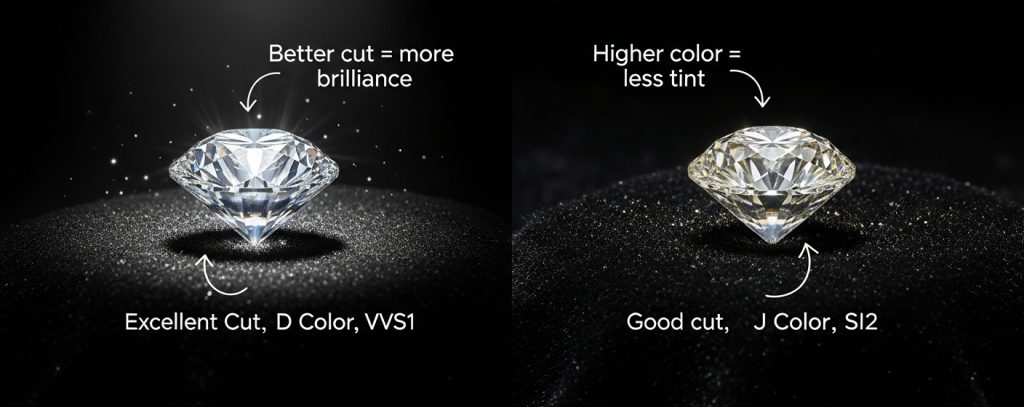
The cut determines how well a diamond reflects light—making it shine brilliantly or look dull.

  • Ideal/Excellent Cut: Maximizes sparkle (most sought-after).

  • Good/Very Good Cut: Still beautiful but slightly less brilliance.

  • Fair/Poor Cut: Noticeably less fire and scintillation.

Example: A well-cut 1-carat diamond can outshine a poorly cut 1.5-carat diamond.

2. Diamond Color: From Colorless to Faint Tint

Diamonds are graded from D (colorless) to Z (light yellow/brown).

  • Best for White Diamonds: D-F (completely colorless, most expensive).

  • Great Balance: G-H (near-colorless, excellent value).

  • Budget-Friendly: I-J (slightly tinted but still attractive in yellow gold settings).

Note: Fancy colored diamonds (pink, blue, etc.) follow a different grading system.

3. Diamond Clarity: Flaws Inside the Diamond

Clarity measures internal imperfections (inclusions) and surface blemishes.

GradeVisibility of Flaws
FL/IFFlawless (extremely rare)
VVS1/VVS2Very hard to see under 10x magnification
VS1/VS2Minor inclusions (good balance of quality & price)
SI1/SI2Visible under magnification (may affect sparkle)
I1-I3Noticeable to the naked eye (budget option)

Tip: VS2 or higher is ideal for engagement rings.

4. Diamond Carat: Diamond Size vs. Quality

Carat = weight (not necessarily size). Bigger isn’t always better if cut or clarity suffers.

  • Budget vs. Size: A 0.9-carat diamond may look as big as a 1-carat but cost significantly less.

  • Spread vs. Depth: A shallow-cut diamond can appear larger but lose sparkle.

Example: A 1-carat, VS1, G-color, Excellent-cut diamond is a classic high-quality choice.

So, Which Diamond Quality Is Best?

It depends on your priorities:

PriorityBest Choice
Maximum SparkleExcellent Cut + G-H Color + VS Clarity
Biggest Size on BudgetSI1 Clarity + I-J Color + Good Cut
Investment/HeirloomD-F Color + VVS/FL Clarity + Ideal Cut

Final Tip:

  • For engagement rings, prioritize cut (sparkle matters most!).

  • For colored diamonds, focus on hue intensity over traditional grading.

You need to know

Thinking About Lab-Grown Diamonds in 2026? The Real Pros and Cons Explained

Lab-grown diamonds have taken the jewelry world by storm, offering real sparkle without the mining. But are they all upside? Or are there trade-offs to consider? This guide walks you through the honest pros and cons of lab diamonds, with insights from Rare Carat, the U.S.-based diamond platform that helps you shop GIA and IGI-certified lab-grown and natural diamonds from trusted U.S. retailers. Whether you’re shopping for a 1 carat engagement ring or exploring bigger, budget-friendlier options, Rare Carat makes

Read More »

What’s the Difference Between Wedding Rings and Wedding Bands?

You’ve probably heard the terms wedding ring and wedding band used like they mean the same thing. And most of the time, they do. But if we’re getting specific, there are a few subtle differences worth knowing especially if you’re shopping for one. This guide breaks down those differences, common overlaps, and how to choose the right one for you. With practical insights from Rare Carat, the tech-forward diamond brand known for its wide range of certified wedding rings and

Read More »
Shopping Cart