
When something expensive is priced significantly lower, hesitation is natural. That reaction is exactly what drives most searches asking “is Rare Carat legit?”. The diamonds look identical on paper, the certificates match, yet the price difference feels unsettling.. just enough to make people wonder whether they’re missing something important.
If you’ve been engagement ring shopping for a while now, you’ve probably asked this question yourself:
“Is Rare Carat legit… or is there a catch??”
The doubt usually starts when you notice things like:
- A 2ct diamond is $1,000–$2,000 cheaper than James Allen or Blue Nile
- The same lab-grown diamond costs half of what a local jeweler quoted
- The specs, certificate, cut, everything looks identical
- Yet Rare Carat barely advertises and doesn’t scream “luxury brand”
So your brain goes: This is too good to be true!! Where’s the catch?? That exact moment is when most buyers open a new tab and search “is Rare Carat legit” to make sure they’re not missing something critical.
This article exists to clear that confusion without any marketing language, fearmongering, or asking you to trust us blindly.
Short Answer: Is Rare Carat Legit?
Yes, Rare Carat is legitimate.
The price differences are real.
And the confusion is understandable.
The reason has less to do with diamond quality and more to do with how pricing is structured in the jewelry industry.
What Rare Carat Actually Is
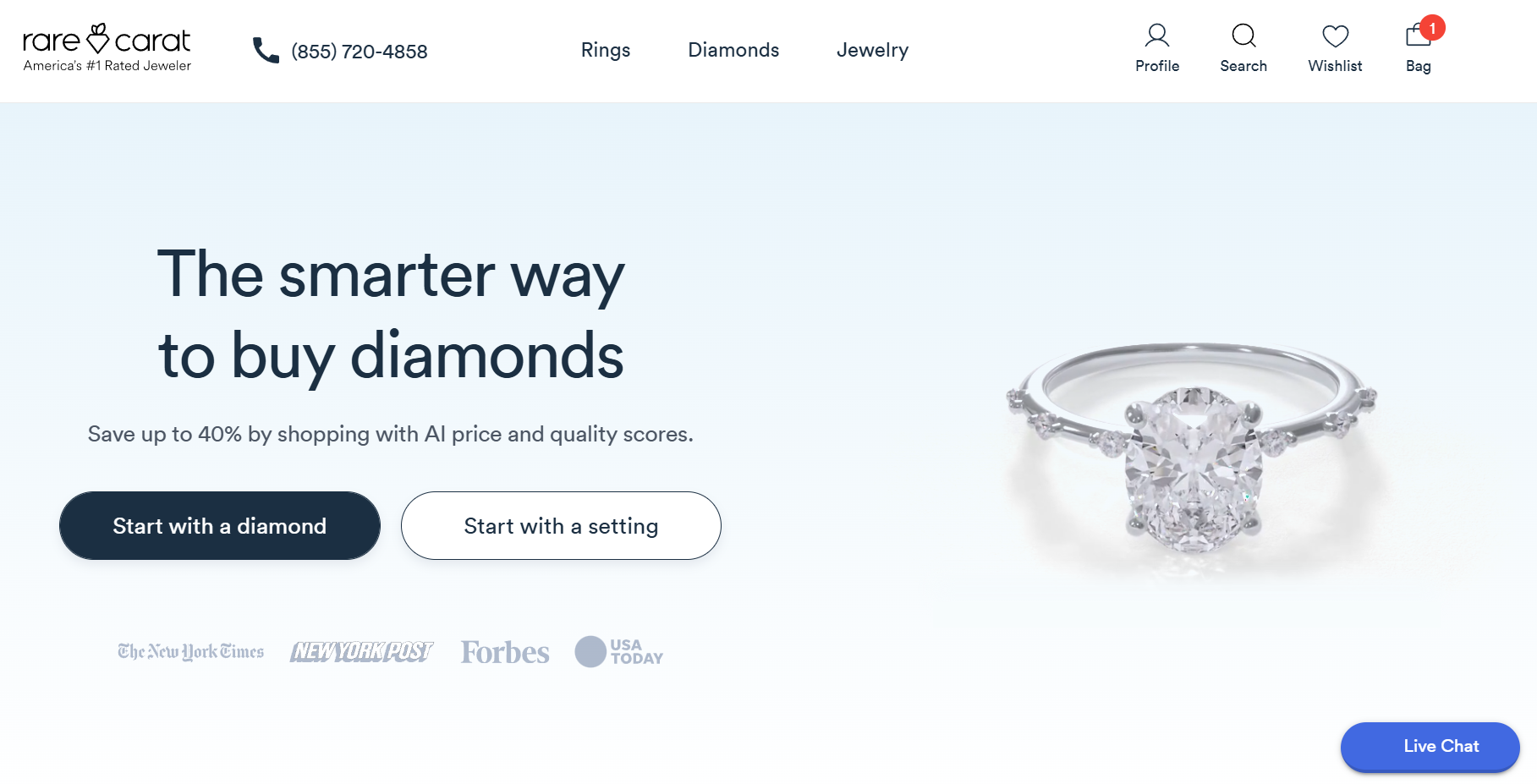
Rare Carat is an online jeweler built around pricing analysis and transparency rather than traditional retail markups. Instead of setting prices based on owned inventory, it uses data to help buyers understand how a diamond is priced across the broader market and whether that price aligns with its quality.
This is why prices on Rare Carat often look lower than those at traditional jewelers or large branded retailers, prompting many buyers to ask is Rare Carat legit. Behind the scenes, Rare Carat’s system evaluates diamonds with similar specifications — cut, color, clarity, carat, proportions, and certification — and compares how they are priced relative to one another, only to show you the best and final price on their website.
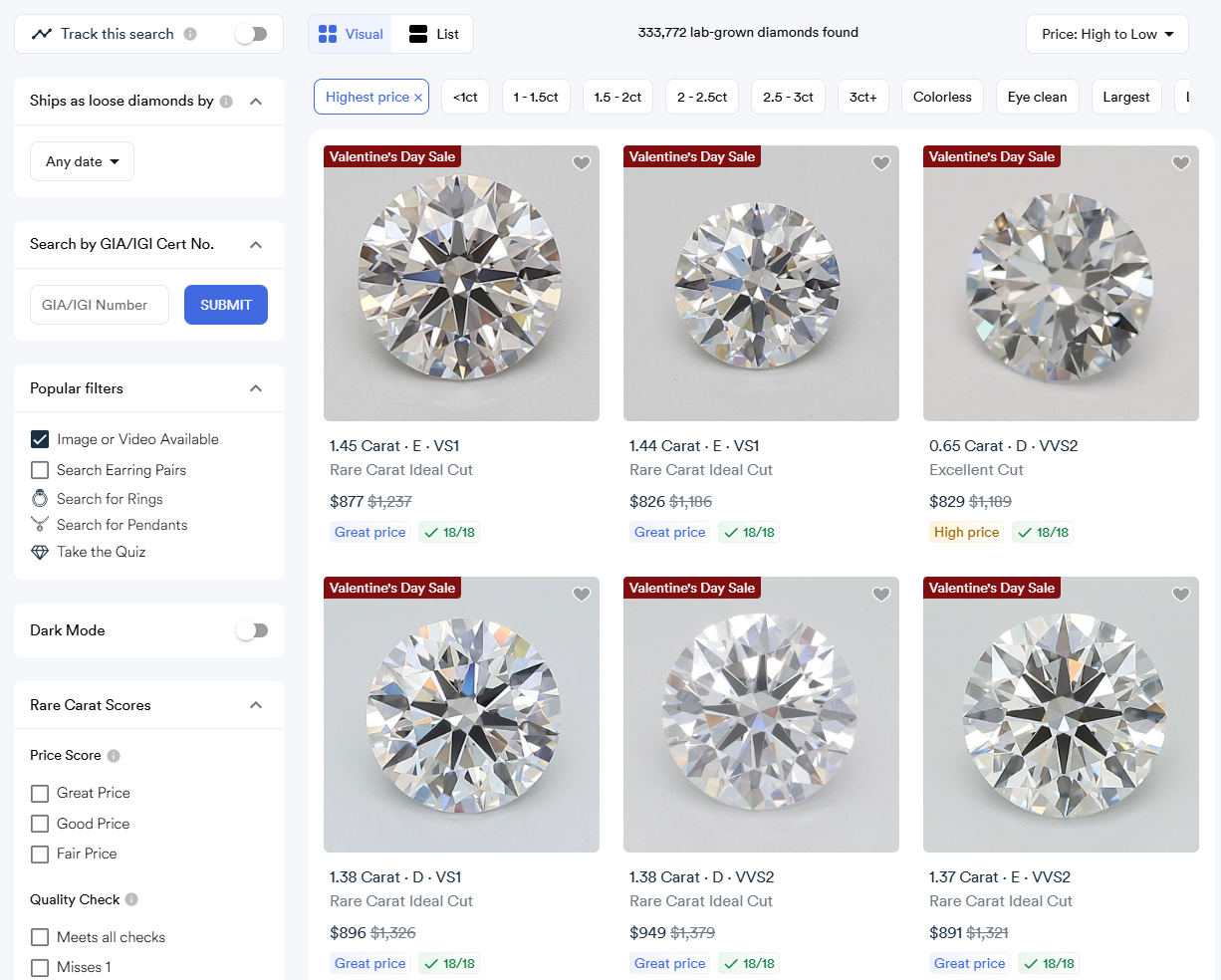
The use of AI is functionally applied by Rare Carat which allows buyers to identify when a diamond is fairly priced, overpriced, or of unusually good value. It automates the same comparison process which an experienced gemologist would perform manually, just at scale. And the result is fewer hidden markups and clearer price context for the ultimate consumer.
Why Rare Carat Diamonds & Engagement Rings Cost Less Than Traditional Retailers (The Real Reason)
Most Buyers Think:
“If it’s cheaper, it must be lower quality.”
The Truth:
In most industries, that’s true. In diamonds, pricing is often driven by retail structure, not product differences.
Here’s the framework I use to explain it:
| The Diamond Pricing Triangle | |||
| Model | Who owns inventory? | Markup | Who pays? |
| Local jeweler | Store | Highest (40–70%) | You |
| Big online retailer | Brand | Medium (25–45%) | You |
| Rare Carat | Supplier | Lowest (10–20%) | Mostly not you |
That structural difference is what creates the price gap.
When buyers see the same diamond at different prices across platforms, it’s usually a reflection of how the retailer prices it, not how the diamond was made.
Margin removal at scale is possible because Rare Carat doesn’t need to:
– stock millions of dollars in diamonds
– recover showroom rent
– push brand premiums
– or lock you into one supplier’s price
So when you see “Same diamond, same certificate, half the price,” it’s not a scam really, it’s a strong system built with consumers in mind.
“But It’s Literally the Same Diamond”
Yes. And that’s the point.
Most natural and lab-grown diamonds are traded across multiple platforms by the original sellers. Rare Carat’s system:
- tracks them
- compares them
- flags overpriced listings
- and provides you the cheapest legit selling price.
James Allen might list it at $6,000. A store might quote $9,000.
Rare Carat finds the supplier selling it for $3,800 and passes that price on by removing traditional retail markups and unnecessary overhead for the customers.
This is price transparency, often mistaken for corner-cutting when people figure is Rare Carat legit.
Note how Rare Carat doesn’t do luxury theater, velvet trays, champagne, emotional hand-holding in-store, or “this diamond chose you” storytelling.
Which brings us to the next important question:
Why do people still buy engagement rings from physical stores or large brands?
Simply because those stores offer a different experience, which might attract a set of buyers.
What physical stores provide:
- immediate in-hand viewing
- emotional reassurance
- in-person service
- a familiar buying environment
What that experience includes in the price:
- rent and overhead
- sales commissions
- marketing costs
- limited inventory
- less price visibility
Neither approach is right or wrong. They simply prioritize different things.
What Reddit Discussions Actually Reveal About Rare Carat
If you wander into discussions on Reddit (one of the largest communities where real buyers share their experiences) around is Rare Carat legit, you’ll see a mix of perspectives rather than a single verdict. Some buyers report solid experiences with their rings and customer support, while others mention the kinds of issues you’d find commonly reported across online fine jewelry retailers.
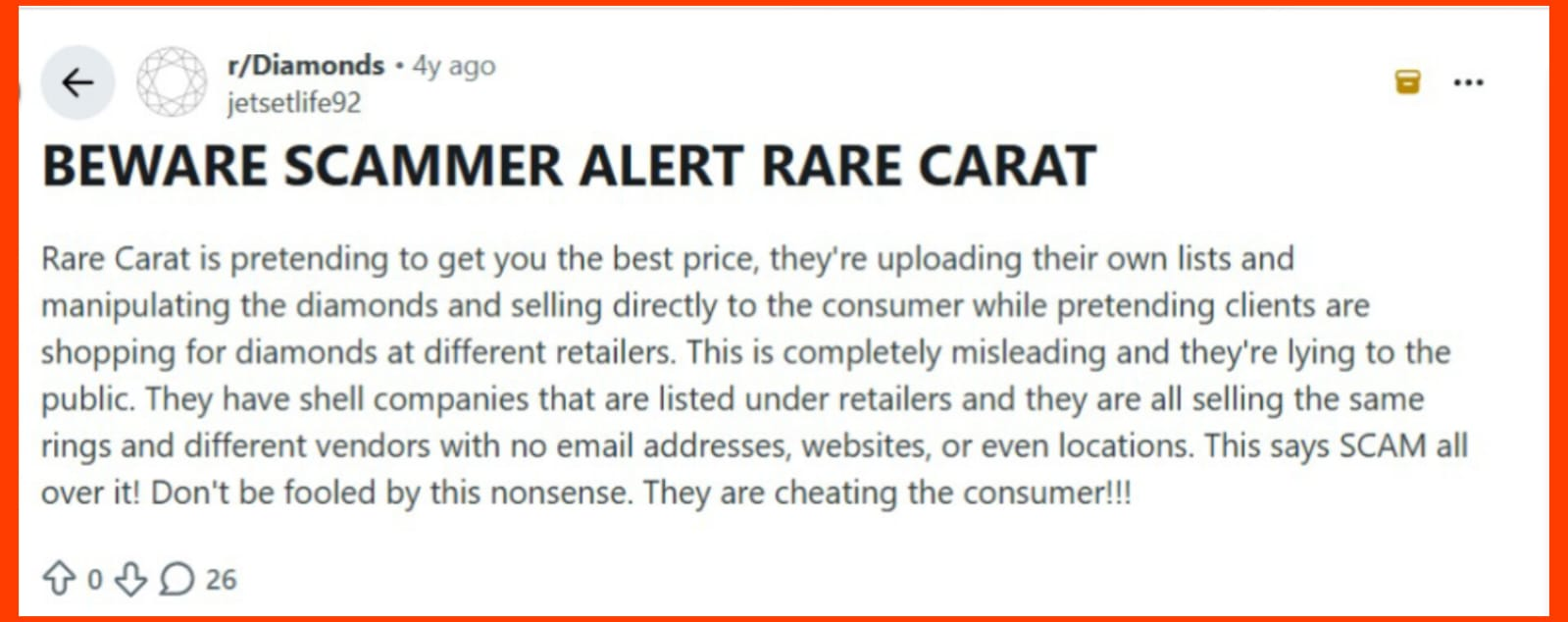
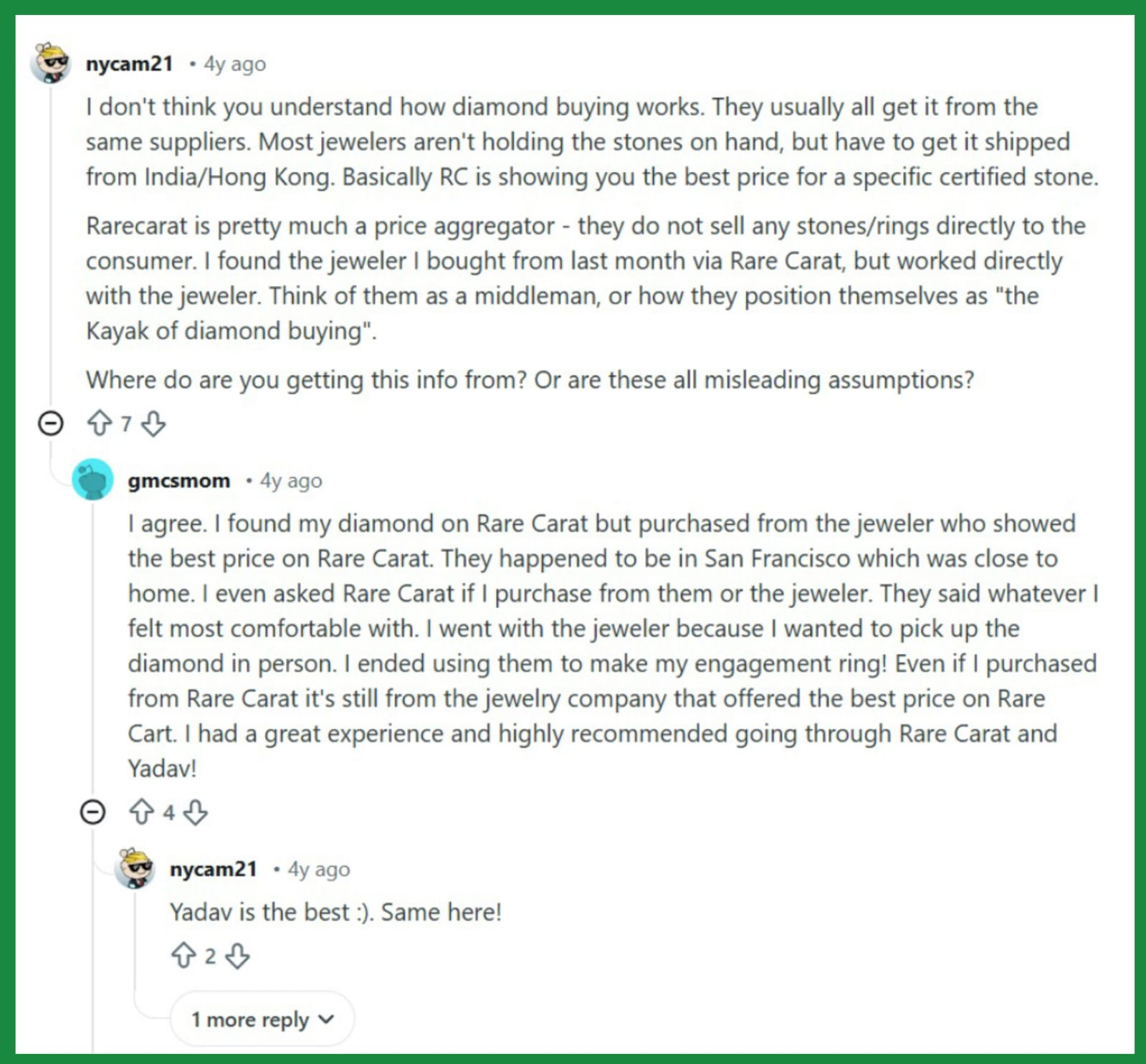
For example, a number of Redditors said they had good communication and support after purchase, felt their final ring matched the description, and even had price match experiences that saved them money. Other posters pointed out situations which required follow-up, or where buyers felt the online process — from photos to shipment timelines — wasn’t as smooth as they hoped, though these tend to be discussed in the context of online buying in general rather than Rare Carat alone.
Across these threads you’ll see two recurring points:
- People reference their personal experience, both positive and negative, rather than claiming Rare Carat is a scam.
- Quality control and communication are common themes: some buyers were delighted with the outcome, others wished specific details had been better managed.
In the context of online fine jewelry where issues like setting adjustments, shipping delays, or remakes are common, Rare Carat’s service record stands out as steady. Most public feedback points to problems being addressed rather than ignored, which is a practical indicator of reliability in the retail category.
What People Commonly Get Wrong About Online Diamond Buying
❌ Mistake 1: Assuming lower price means lower quality
Price differences usually come from retail structure, not diamond quality alone.
❌ Mistake 2: Not checking certificates and visuals properly
Always verify GIA / IGI / GCAL grading and HD quality images & 360° videos. Rare Carat provides them — you still need to review them.
❌ Mistake 3: Ignoring the setting details
The diamond may be perfect, but settings vary by design. Ask questions. Take the available expert’s help.
❌ Mistake 4: Buying without using expert review
Rare Carat’s certified gemologists will review stones for free on your behalf. Use that advantage even if you’re sure on your own.
Buying a diamond online isn’t a gamble, it’s a strategy. Platforms like Rare Carat make it safer by putting transparent pricing, certification, HD visuals, and expert reviews in one place, so informed buyers actually get more control than they would in-store.
A Simple Safety Checklist Before You Buy
If you’re using Rare Carat to buy your first engagement ring online, follow this order and you’re safe:
✔ Filter only GIA / IGI / GCAL certified diamonds
✔ Watch the 360° video to check cut, symmetry, and visible inclusions
✔ Treat the setting as a separate decision (confirm metal + prong style etc.)
✔ Ask a gemologist to review your selection and clear any doubts you have
✔ Review the return window & after-sales services you get as protection
✔ Inspect the ring immediately on arrival
✔ Avoid rushing — count on the customer service if you need any help afterwards.
Summary: Is Rare Carat Legit?
Yes. Completely.
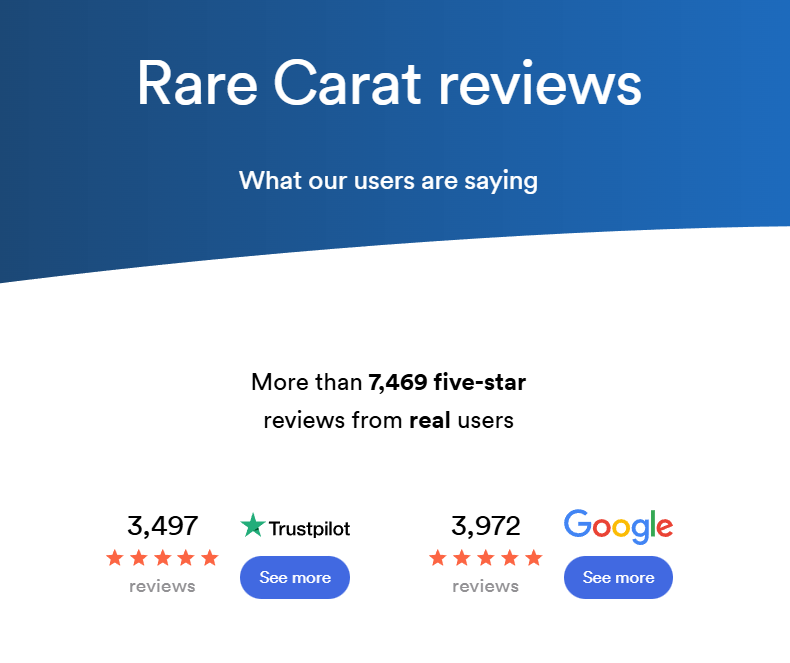
It’s cheaper because:
– it removes middlemen
– it exposes pricing
– it runs on data, not emotion
– it passes savings to the buyer
It feels too good to be true because:
– The diamond industry trained us to expect opacity
– not transparency
– and definitely not discounts
Rare Carat operates on a different retail logic than most traditional jewelers, which explains both the pricing difference and the confusion around it.
If you want full control, visibility, and pricing context, Rare Carat is a rational option for buying an engagement ring online in 2026.
If you want romance wrapped in velvet and a flute of champagne, go to a store. Just don’t confuse expensive with better.
Frequently-Asked Questions