Which Diamond Quality Is Best? A Simple Guide

Choosing the best diamond depends on your priorities—whether it’s sparkle, size, or long-term value. But how do you compare different diamonds? The answer lies in the “4 Cs” (Cut, Color, Clarity, and Carat), the universal grading system for diamonds.

Let’s break down each factor to help you decide what “best” means for you.

Which Diamond Quality Is Best?

1. Diamond Cut: The Most Important Factor for Sparkle

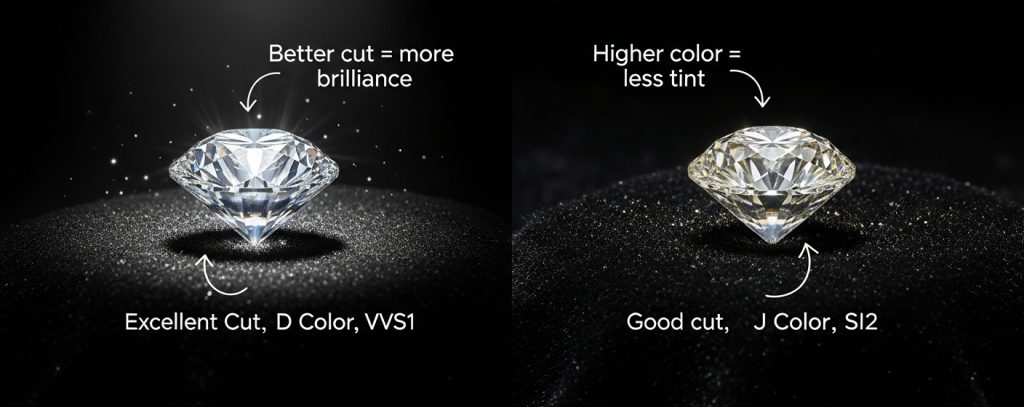
The cut determines how well a diamond reflects light—making it shine brilliantly or look dull.

  • Ideal/Excellent Cut: Maximizes sparkle (most sought-after).

  • Good/Very Good Cut: Still beautiful but slightly less brilliance.

  • Fair/Poor Cut: Noticeably less fire and scintillation.

Example: A well-cut 1-carat diamond can outshine a poorly cut 1.5-carat diamond.

2. Diamond Color: From Colorless to Faint Tint

Diamonds are graded from D (colorless) to Z (light yellow/brown).

  • Best for White Diamonds: D-F (completely colorless, most expensive).

  • Great Balance: G-H (near-colorless, excellent value).

  • Budget-Friendly: I-J (slightly tinted but still attractive in yellow gold settings).

Note: Fancy colored diamonds (pink, blue, etc.) follow a different grading system.

3. Diamond Clarity: Flaws Inside the Diamond

Clarity measures internal imperfections (inclusions) and surface blemishes.

GradeVisibility of Flaws
FL/IFFlawless (extremely rare)
VVS1/VVS2Very hard to see under 10x magnification
VS1/VS2Minor inclusions (good balance of quality & price)
SI1/SI2Visible under magnification (may affect sparkle)
I1-I3Noticeable to the naked eye (budget option)

Tip: VS2 or higher is ideal for engagement rings.

4. Diamond Carat: Diamond Size vs. Quality

Carat = weight (not necessarily size). Bigger isn’t always better if cut or clarity suffers.

  • Budget vs. Size: A 0.9-carat diamond may look as big as a 1-carat but cost significantly less.

  • Spread vs. Depth: A shallow-cut diamond can appear larger but lose sparkle.

Example: A 1-carat, VS1, G-color, Excellent-cut diamond is a classic high-quality choice.

So, Which Diamond Quality Is Best?

It depends on your priorities:

PriorityBest Choice
Maximum SparkleExcellent Cut + G-H Color + VS Clarity
Biggest Size on BudgetSI1 Clarity + I-J Color + Good Cut
Investment/HeirloomD-F Color + VVS/FL Clarity + Ideal Cut

Final Tip:

  • For engagement rings, prioritize cut (sparkle matters most!).

  • For colored diamonds, focus on hue intensity over traditional grading.

You need to know

Cushion Cut Diamonds: Shape, Proportions, Certification, and Buying Checks

Cushion Cut Diamonds: Shape, Proportions, Certification, and Buying Checks Square and elongated cushion outlines can have different face-up coverage and facet patterns even at the same carat weight. Editorial note: This article explains how to evaluate cushion cut diamonds rather than treating the shape name as a guarantee of appearance. A cushion can look square, elongated, bright, chunky, or softly “crushed ice” depending on its outline and facet arrangement. What are cushion cut diamonds? A cushion cut diamond has a

Read More »

Most Popular Diamond Cuts for Engagement Rings

Most Popular Diamond Cuts for Engagement Rings The most popular diamond cuts for engagement rings include round brilliant, oval, cushion, emerald, pear, marquise, and princess. Round brilliant remains the conventional choice for maximum sparkle, while oval and elongated shapes can create a larger-looking face-up appearance. Cushion, emerald, pear, marquise, and princess cuts offer distinct outlines and styling trade-offs. The right choice depends on faceting, proportions, durability, setting design, and the wearer’s preferences—not popularity alone. Which Diamond Cuts Are Most Popular

Read More »
Shopping Cart